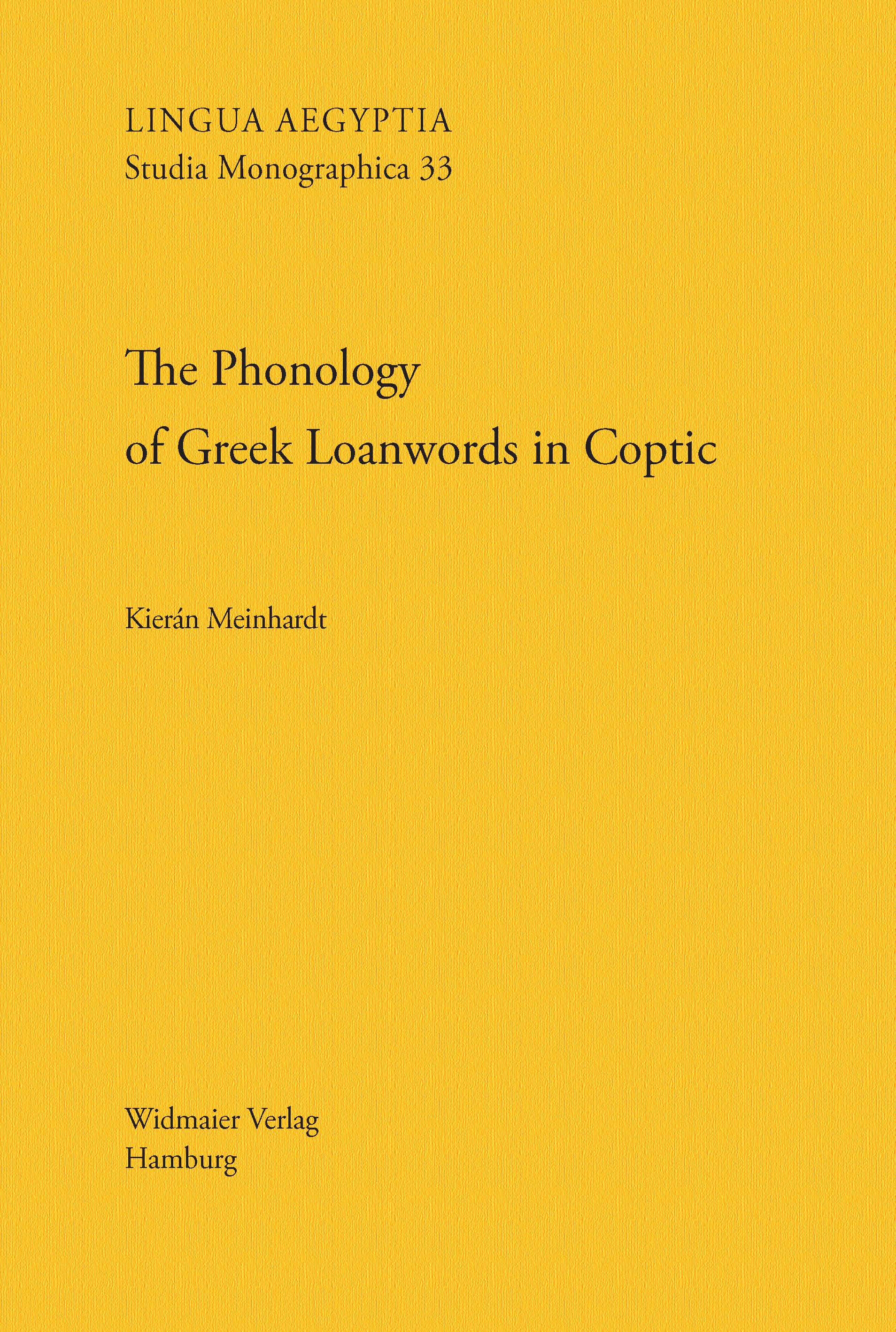
Coptic, the latest stage of the Egyptian language, received into its lexicon several thousand words of Greek origin. The manner in which these words were pronounced by Coptic speakers has not been studied systematically for more than half a century. The present study addresses the question through the evidence of spelling: drawing upon the Database and Dictionary of Greek Loanwords in Coptic (DDGLC), it employs an automatic procedure to identify some 45,000 departures from standard Greek orthography among nearly 200,000 attestations from six dialects and a millennium of textual tradition. These departures are examined by the combined methods of contact phonology and corpus statistics.
Three sets of questions are pursued: how well Coptic writers knew Greek at different periods, across dialects, and in differing genres; in what manner Greek sounds were accommodated to Coptic phonology, and how the dialects differ in this regard; and which graphematic system ultimately emerged. The author contends that Greek loanwords preserved conservative Koine values in their consonants whilst adopting contemporary Greek pronunciation in their vowels, and relates this split to the consonantal nature of the roots of Egyptian words.
The deviation data are made available as a citable open dataset with a searchable companion website. Appendices reconstruct the pronunciation of the most frequent loanwords, together with sample passages in all six dialects.
Kierán Meinhardt
The Phonology of Greek Loanwords in Coptic
Lingua Aegyptia Studia Monographica 33
Hamburg, to be published in November 2026
doi: https://doi.org/10.37011/studmon.33
xx+162 pages, paperback,
ISSN: 0946-8641
ISBN (Paperback): 978-3-943955-33-0
ISBN (PDF): 978-3-943955-95-8

Dieses Werk ist lizenziert unter einer Creative Commons Namensnennung-Nicht kommerziell 4.0 International
Hamburg, to be published in November 2026
doi: https://doi.org/10.37011/studmon.33
xx+162 pages, paperback,
ISSN: 0946-8641
ISBN (Paperback): 978-3-943955-33-0
ISBN (PDF): 978-3-943955-95-8
Dieses Werk ist lizenziert unter einer Creative Commons Namensnennung-Nicht kommerziell 4.0 International
Order a print copy
- Pre-order Price (valid from October 2026 until November 2026)
Shipping: free (Germany), reduced rate (worldwide) 39.00 € - Price (valid from November 2026) 49.00 €
- Reduced price for subscribers to LingAeg (Journal) (valid from November 2026) 39.00 €
- NOTICE:
Choose your subscription type when entering your billing information.
All prices incl. VAT 7% and excl. shipping. Orders from non-EU customers and from VAT registered customers (EU) will be exempt from German VAT.